

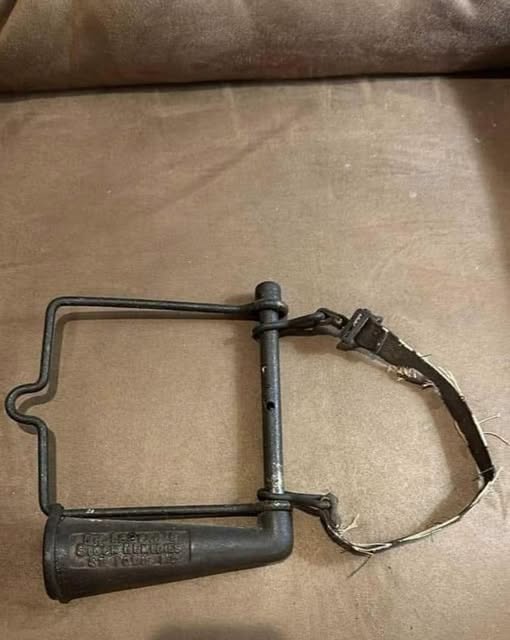
How to Tell If You Have a Horse Drencher
If you’re trying to identify an unfamiliar antique veterinary tool, look for a combination of characteristics rather than relying on one feature.
Possible clues include:
- A cylindrical or elongated reservoir
- A long delivery tube
- A mouthpiece or bit-like component
- A plunger or pumping mechanism
- Brass or other metal construction
- A ring or hook for handling or storage
- Evidence of repeated use or wear
However, not every object with a curved tube is a horse drencher.
There were many specialized veterinary and agricultural implements, and some can look remarkably similar.
If an item has maker’s marks, patent numbers, engraved names, or other identifying information, those details can be particularly helpful.
How Old Could It Be?
Horse-drenching instruments have a long history, so there’s no single date that applies to every example.
The Michigan State University collection includes a horse drench dated to approximately 1720, while the Science Museum Group has a horse drencher dating from 1960–1975.
That wide range is important.
An antique-looking brass drencher shouldn’t automatically be labeled “Victorian” or “19th century” without examining its construction and provenance.
Maker’s marks, patents, design features, and documentation can help establish a more reliable date.
Is an Antique Horse Drencher Valuable?
Possibly—but age alone doesn’t determine value.
Collectors may consider:
- Age
- Rarity
- Manufacturer
- Condition
- Completeness
- Material
- Historical significance
- Provenance
- Unusual design features
A common example may have modest value, while an especially early, rare, or well-documented instrument could be considerably more interesting to collectors.
If you’re curious about the monetary value of one you’ve inherited, compare it with documented museum examples and seek an appraisal from someone experienced with antique medical or veterinary instruments.
Should You Clean an Old Brass Drencher?
Be careful.
If you’ve found an antique instrument, aggressive polishing can remove surface patina and potentially damage historically important details.
Before cleaning it, photograph the object from several angles and record any markings.
For an ordinary decorative piece, gentle cleaning may be appropriate. For something potentially rare, however, it’s worth consulting an antique specialist or museum professional first.
And because the object was historically used for administering veterinary treatments, don’t assume an old drencher is suitable for modern animal use. Antique equipment may have unknown contamination, deterioration, or mechanical problems, and modern veterinary treatment should be left to qualified professionals.
The Strawberry Surprise: What Tiny White Creatures in Your Berries May Really Mean
The Plant Growing in Many Yards That People Have Used for Generations

Do You Wake Up Between 3 and 5 in the Morning? “It Could Be a Sign of Spiritual Awakening.”
My neighbor gave me a bag of these. Anyone know what they are? How are you supposed to eat them? 😭 ᅠ
5 Symptoms of a Mini Stroke in Seniors That Shouldn’t Be Ignored