
Glad I saw this!

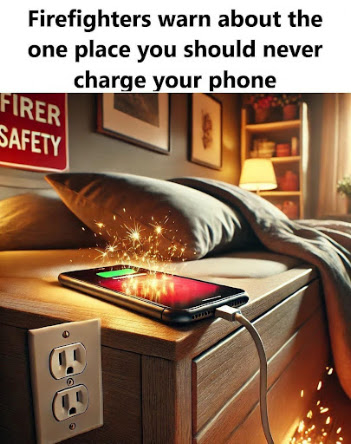
The No. 1 Forbidden Zone: Under the Pillow or on the Bed. This practice is the cardinal sin of phone charging, a confluence of nearly every risk factor identified by engineers and firefighters.
Heat Entrapment and the Insulation Effect: A phone charging, even normally, generates waste heat from both the battery’s electrochemical reactions and the voltage conversion in the charging circuitry. A hard, flat surface like a desk allows this heat to dissipate via convection and radiation. A pillow, mattress, or blanket acts as a highly effective thermal insulator. It traps the heat around the device, creating a localized oven. The phone’s internal temperature can soar well beyond its safe operating range (typically 0°C to 35°C / 32°F to 95°F).
Flammable Fuel Source: Modern bedding is often made from highly combustible materials: memory foam, polyester fills, cotton, and latex. When a phone enters thermal runaway, the ejected gases can ignite at temperatures far below an open flame. The bedding provides immediate, ample fuel, allowing a smoldering fire to escalate into a full-blown bedroom blaze in minutes.
The Unattended, Unconscious Hours: This practice is almost exclusively an overnight one. For 6-8 hours, the hazardous condition is left entirely unsupervised. A fire that starts at 2 AM has a significant head start before smoke alarms wake inhabitants, and sleepers are at their most vulnerable to smoke inhalation, the leading cause of fire-related deaths.
Physical Stress: Phones shoved under pillows or tossed on beds are often subjected to twisting, pressure, and bending during sleep, potentially damaging the battery cell internally.
The Demographics of Risk: This behavior is most prevalent among adolescents and young adults, for whom the phone is a primary social lifeline. The desire to have the device within immediate reach upon waking, or to check notifications discreetly, overrides nascent safety considerations. It’s a habit formed out of convenience and intimacy with technology, but one that ignores its physical reality.
Beyond the Bed: Other High-Risk Domestic Locations:
The Sofa or Armchair: Similar to a bed, soft furnishings insulate heat and are often surrounded by other flammable materials (cushions, newspapers, blankets).
Carpeted Floors: Placing a charging phone directly on a carpet pile impedes airflow and can be a hazard if stepped on.
Bathrooms: The combination of high ambient humidity and the presence of conductive water sources creates a risk of electric shock and corrosion, though less of a fire risk unless placed on towels or bathmats.
Inside Closed Vehicles: A car left in the sun can become an oven, with cabin temperatures exceeding 60°C (140°F). A phone or power bank left on the dashboard is subjected to extreme thermal abuse, which can degrade the battery or trigger failure.
continued on the next page