
Why Did Cars Have Economy Mode in the First Place?
To understand the “E” gear, you have to go back to the 1970s.
The oil crises of 1973 and 1979 changed the automotive world forever. Fuel prices skyrocketed, long gas station lines formed across the country, and suddenly fuel economy became one of the biggest concerns for drivers.
Automakers scrambled to make vehicles more efficient.
That’s when features like:
Overdrive transmissions
Smaller engines
Lighter vehicle designs
Economy shifting modes
started appearing in cars across America and Japan.
Manufacturers like General Motors, Ford Motor Company, Honda, and Chrysler experimented with Economy modes in various models during the late 1970s and early 1980s.
For many drivers back then, saving even a little fuel mattered.
How Economy Mode Worked
In normal “D” (Drive) mode, transmissions balanced fuel efficiency with performance. The engine would rev higher before shifting into the next gear.
But in “E” mode:
The car shifted earlier
Engine RPM stayed lower
Fuel consumption decreased slightly
Some vehicles even connected Economy mode to overdrive systems, engaging higher gears more aggressively during cruising.
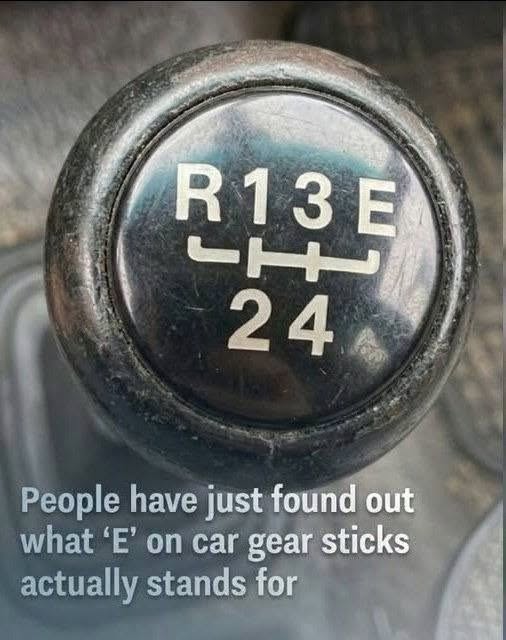
In certain cars, “E” appeared directly on the gear selector. In others, there was a separate “Economy” or “Econ” button on the dashboard.
It wasn’t fancy by modern standards — but at the time, it was innovative.
Why Did the “E” Gear Disappear?
By the late 1980s, the mysterious “E” slowly vanished from most vehicles.
The reason was simple: technology improved.
Modern automatic transmissions became electronically controlled, allowing onboard computers to constantly adjust shifting patterns automatically. Drivers no longer needed to manually select Economy mode because the car could manage efficiency on its own.
At the same time:
Overdrive became standard
Fuel injection replaced older systems
Engines became smarter and more efficient
Eventually, the old “E” gear became unnecessary.
Its job was quietly absorbed into the intelligent driving systems we use today.
The Return of Eco Mode — Just in a Different Form
Ironically, the idea behind the old “E” gear never disappeared.
Today, many modern vehicles still include:
Eco Mode
Fuel-saving drive settings
Smart throttle control
Adaptive transmissions
The difference is that now everything happens digitally.
Pressing an “Eco” button in a modern car can adjust:
Transmission shift timing
Throttle sensitivity
Air conditioning performance
Cruise control behavior
In some hybrid and electric vehicles, Eco modes can even extend driving range significantly.
The old mechanical “E” gear may be gone, but its philosophy lives on everywhere.
Why Younger Drivers Are Suddenly Discovering It
So why has the “E” gear become such a mystery online recently?
A few reasons explain it.
1. Older Cars Are Making a Comeback
As used car prices rise, younger drivers are buying older vehicles more often — including classic cars from the 70s and 80s.
That means more people are encountering unfamiliar dashboard symbols and forgotten driving features for the first time.
2. Social Media Loves Weird Car Features
Photos of unusual dashboards regularly go viral on platforms like TikTok, Reddit, and Instagram.
Someone posts a picture of a mysterious “E” on a gear selector, and suddenly thousands of people are trying to solve the mystery together.
3. Automotive Nostalgia Is Trending
YouTube channels and car enthusiasts have helped revive interest in vintage automotive technology.
Features that older generations considered normal now feel fascinating to younger audiences who grew up with touchscreens and fully digital cars.
Should You Use “E” Mode If Your Car Has It?
If you happen to own an older car with an Economy setting, it can still be useful in certain situations.
Best Times to Use It
Highway cruising
Flat roads
Long-distance driving
Situations where fuel economy matters more than acceleration
Avoid Using It When
Merging onto highways
Driving uphill
Towing heavy loads
Needing quick acceleration
For everyday city driving, most people preferred regular “D” mode because the car simply felt more responsive.
Other Strange Gear Letters Drivers Forget About
The “E” gear isn’t the only forgotten transmission symbol that confuses people today.
Older cars also featured:
L (Low): Keeps the car in lower gears for hills or towing
2: Locks the transmission into second gear
S (Sport): Improves acceleration performance
M (Manual): Allows manual gear selection
B (Brake): Used in hybrids for stronger regenerative braking
Each letter tells a story about how automotive technology evolved over time.
Continued on next page